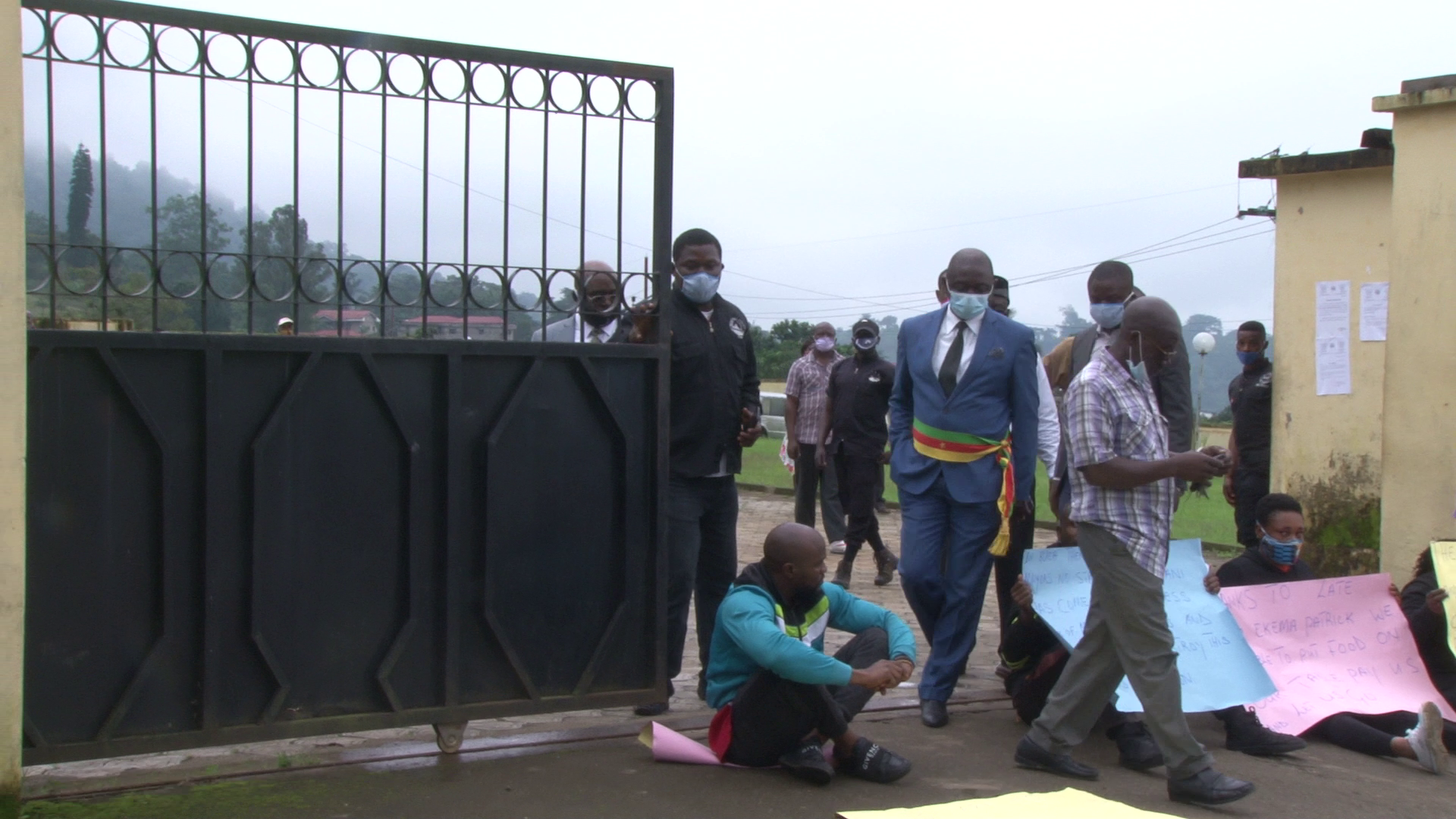
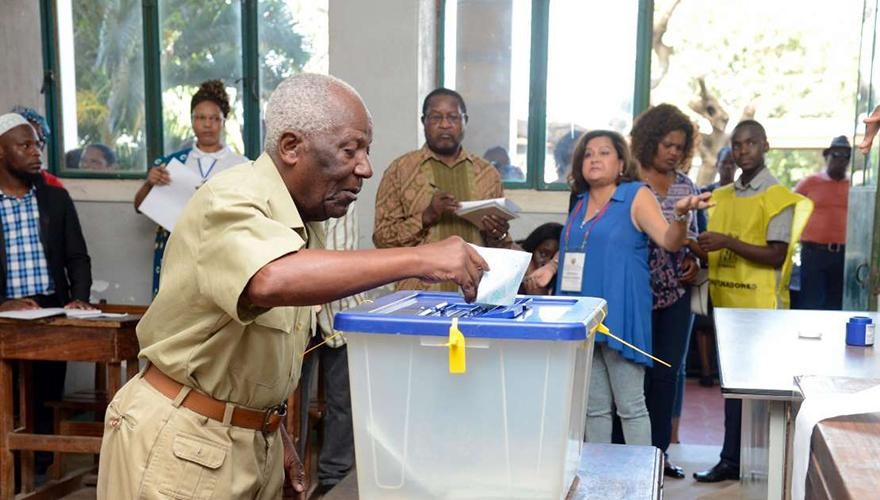
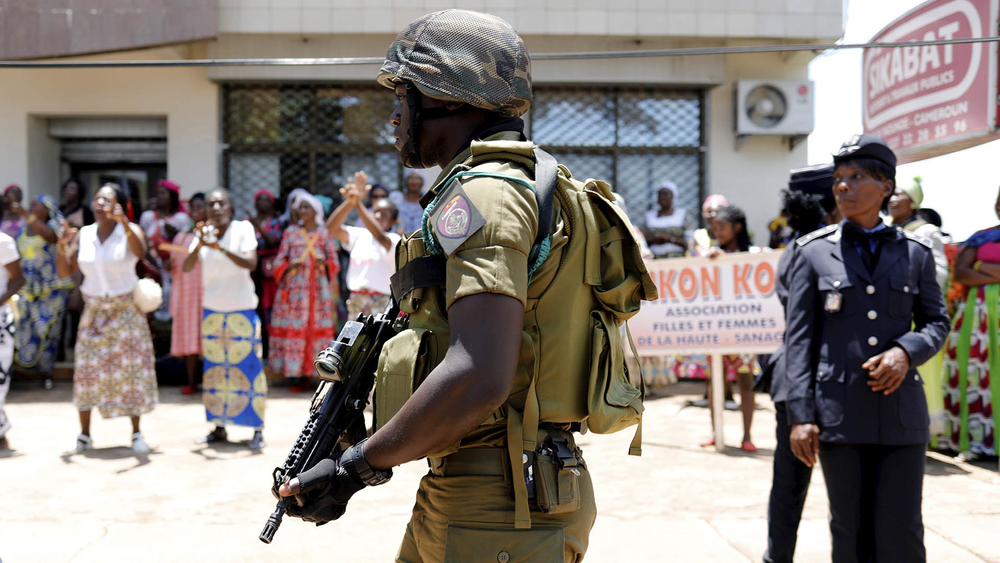
Security guards walk outside the Yaoundé polling station where President Paul Biya voted in Cameroon's presidential election on 7 October, 2018. (Zohra Bensemra/Reuters)
NAIROBI
Cameroonian government forces and rival anglophone separatists have stepped up arrests, abductions, and deadly attacks in the two months leading up to Sunday’s parliamentary and municipal elections, causing a devastating fallout for civilians that looks set to worsen.
Perceived marginalisation by the francophone majority of the minority English-speaking community – some 20 percent of the population, concentrated in the Northwest and Southwest regions – saw a separatist insurgency erupt in Cameroon in October 2016.
But what has until recently been a low-intensity conflict – albeit one that has left an estimated 3,000 civilians dead, and nearly 730,000 people displaced at home and abroad – now risks entering a new and more dangerous phase, according to aid workers, residents, and experts.
Why has violence spiked?
In November 2019, President Paul Biya set a date for the elections, sparking unprecedented violence, destruction, and human rights abuses across the two western regions – referred to collectively by the separatists as the Southern Cameroons or the Republic of Ambazonia.
“This is the first time since the anglophone crisis began that I have seen this level of violence,” Ilaria Allegrozzi, senior researcher at Human Rights Watch, told The New Humanitarian. “I have never seen so many incidences, attacks, and reports [of violence] as I am seeing now.”
Previously, the conflict had been marked by periodic peaks in violence coinciding with public holidays and court proceedings for arrested separatist leaders. “This has now been taken to another level,” Allegrozzi said.
Shortly after Biya’s election announcement, on 1 December, separatists attempted to shoot down a commercial plane landing in Bamenda, the capital of the Northwest region. A separatist leader, Cho Ayaba, claimed it was a legitimate target as commercial planes were used to transport soldiers and weapons.
“We are bent on doing anything, anything that it takes for this election, this sham election, this colonial election, not [to be held] in Ambazonia.”
The separatists have declared Sunday’s polls illegal and stepped up operations, reportedly abducting 40 candidates in December and burning down a government election office in January.
“In Ambazonia, we do not have elections, because we do not have a government,” Fombat Forbah Dieudonné, a spokesperson for the Ambazonia Restoration Forces – the defence arm of the self-declared interim government of Ambazonia – told TNH.
“Our government is still an interim government that operates from the diaspora,” Dieudonné said. “We are still fighting to restore our independence.”
Separatists have called for a “lockdown” between 7 and 12 February in the two western regions, with restrictions on movement, and closures of schools, markets, and businesses.
They have issued threats of violence and death to those who do not observe the lockdown via social media, WhatsApp, and separatist-run television and radio stations. Separatists have also called for humanitarian organisations to suspend activities during the lockdown.
“We are bent on doing anything, anything that it takes for this election, this sham election, this colonial election, not [to be held] in Ambazonia,” Dieudonné said. “Our restoration forces have openly declared that there are going to be no elections taking place in their territory.”
The UN has recorded “a significant increase in incidents against civilians since December, including killings and burning of houses and villages with consequent displacement of civilians”, James Nunan, head of the UN’s aid coordination body, OCHA, in the two regions, told TNH.
How are humanitarian needs growing?
As the crisis escalates, civilians are increasingly caught in the crossfire, and assistance is harder for them to attain.
“The closure of over 40 percent of the health centres and the escalation of the crisis because of the elections is likely to intensify the deteriorating health conditions for the over four million people living in the English-speaking regions,” noted independent humanitarian analysts ACAPS on 21 January.
The International Crisis Group estimates that at least 3,000 civilians have been killed since 2016. Across the Northwest and Southwest regions, an estimated 600,000-700,000 children have been out of school since 2016, as 80 percent of schools there remain closed.
As of 31 December, OCHA estimated that 679,393 people had been internally displaced by the conflict, and another 51,000 people have crossed the border into neighbouring Nigeria.
Between 9 and 15 December, 5,475 people were displaced in the Northwest region alone, fleeing military raids and clashes between separatist groups and government security forces. As of 20 December, no humanitarian assistance had been delivered to those newly displaced, OCHA said.
“The humanitarian situation is increasingly worrying.”
Most of the internally displaced people are sheltering in the bush with little access to shelter, food, or healthcare. Providing humanitarian assistance has proved challenging.
The national government has “tough procedures that must be cleared, and passages need to be negotiated with non-state armed groups”, explained Fon Nsoh, a coordinator for the Community Initiative for Sustainable Development (COMINSUD), a local aid NGO based in Bamenda.
“The humanitarian situation is increasingly worrying,” OCHA’s Nunan said. And it is likely to get worse, especially as displacement figures for the recent uptick of violence in January and early February are yet to be properly recorded and needs assessed.
Are civilian abuses being committed?
Whereas during the conflict’s first two years, violence against civilians and human rights abuses were perpetrated largely by government security forces, HRW’s Allegrozzi said such actions have more recently been “coming from both sides”.
“Abuses are being committed, I would say now, in an almost equal manner both by the separatists and the security forces,” she explained. “If, at the beginning, we observed more abuses from the government side, I would say that now, especially with these elections upcoming, that the frequency, the scale, and depravity of abuses committed by the separatists is really serious.”
According to Allegrozzi, armed separatist groups have targeted and assaulted civilians willing to participate in the elections. They have assaulted, threatened and tortured members and supporters of political parties, including the ruling party and Social Democratic Front, the main opposition party.
Human Rights Watch documented at least 25 cases of kidnapping of candidates to the elections since mid-November 2019, and heard reliable reports of over 100 people kidnapped by the separatists over the same period. Separatist groups have also used intimidation and violence to keep children and teachers out of schools.
Most recently, on 1 February, separatists attacked a military convoy in the Northwest region carrying a minister travelling to Mbengwi – the main town in Momo district – for election campaign activities.
“People are afraid. Not so much because they don’t want to vote, but for fear of being abused.”
Civilians have condemned the separatists’ increasingly brutal tactics.
“We all agree that the governance system is not the best,” said Magdaline Agbor Tarkang, Southwest regional president of the Cameroon Women’s Peace Movement, a local NGO. “But again, I can attest to the fact that more than 90 percent of our population don’t agree with that violence, [the] maiming of the same people you are trying to protect, killing them, abducting.”
In this climate of violence and intimidation, “people are afraid”, Tarkang told TNH. “Not so much because they don’t want to vote, but for fear of being abused. The situation is not very convenient for very free and fair elections to take place.”
Government security forces – including military personnel, gendarmes, and police – have also killed civilians, burned hundreds of houses and dozens of villages, and arbitrarily arrested and tortured hundreds of people suspected of having links to the various separatist groups.
They have “failed to adequately address the threats posed by the armed separatists", and “conducted abusive security operations resulting in an excessive use of force, unlawful killings and destruction of property,” said Allegrozzi.
Are aid workers being targeted?
On the morning of 30 January, separatists kidnapped four staff from COMINSUD.
According to an incident report provided by the local aid NGO, abductors accused the organisation of “working with the government in registering people for elections” and “harbouring a staff of French expression serving as a spy under the pretext of doing humanitarian assistance”.
Three of the four staff members who were abducted were beaten and “subjected to different forms of psychological torture and threats”, the report said. The organisation, working alongside other humanitarian actors, negotiated the successful release of the staff the following day.
Also on 30 January, three staff from the Martin Luther King Jr. Memorial Foundation were abducted in Bambili, a town east of Bamenda, after separatists mistook their suggestion box for a government election box. All were later released without ransom.
What are the latest conflict dynamics?
Armed separatist groups are becoming more organised, mobilising resources from abroad, and carrying out more sophisticated attacks against government security forces.
It is estimated that between 800 and 1,000 government security forces have been killed since the conflict began in 2016. Some 300 separatist fighters have been killed, according to Dieudonné, the separatist spokesperson.
“Our life is no longer safe.”
Since early January, the military has reinforced the Northwest and Southwest regions, deploying some 700 additional gendarmes, carrying out deadly military raids and clashing with separatist groups, according to a recent report by the International Crisis Group.
According to several witnesses, government security forces carried out military raids on Sunday in Owe and Ikata villages, both in Fako district in the Southwest region, killing three civilians in Ikata. Military raids carried out since the new year have resulted in at least 28 deaths, including six in Donga Mantung, three in Babessi-Ndop, and nine in Mbiame Kumbo.
On 3 and 4 February, government security forces descended on the town of Muyuka, killing three civilians, burning down at least 45 houses, detaining some 300 people, and displacing an estimated 3,000, many of whom fled into the bush, according to eyewitness accounts.
“Our life is no longer safe,” one Muyuka resident displaced by the recent raid told TNH.
What caused the conflict?
Anglophone discord with the majority francophones has roots in the colonial era when once German Kamerun was handed over to Britain and France after World War I. The territories were granted independence in the 1960s, and anglophone Southern Cameroons voted to join francophone Cameroon to form one united country. Since then, anglophone Cameroonians have felt economically, politically, and socially marginalised.
The crisis escalated in October 2016 when peaceful protests, led by anglophone teachers and lawyers, were met with deadly force. Separatist groups took up arms, initially demanding for a return to the pre-1971 federal system that would give the anglophone regions more autonomy from an increasingly centralised government.
Through 2017, government security forces arrested and detained separatist leaders and continued a deadly crackdown on protesters and civilians.
Calls for autonomy increasingly turned to calls for outright secession and the formation of a country called Ambazonia. Separatist groups proliferated and retaliated. Tensions heightened. President Biya labelled the Ambazonia Defense Forces and other separatist groups “terrorists” and declared war against them in late 2017.
No serious attempt at mediation or exploration of greater autonomy for the western regions has yet been undertaken. Biya announced a “major national dialogue” last year, but it sidelined the separatist leaders and lacked any participation from the international players seen as key to resolving the crisis, namely the African Union and former colonial powers Britain and France.