Dinner, Drinks, and a Near-Fatal Ambush for U.S. Diplomats
September 08, 2016
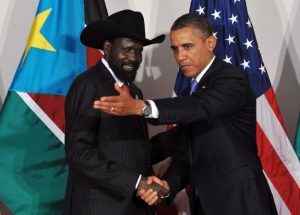
President Salva Kiir has been feted by the White House. So why are his goons trying to kill American officials in South Sudan? BY COLUM LYNCH* [caption id="attachment_32656" align="alignleft" width="300"] South Sudan President Salva Kiir with U.S President Barack Obama[/caption] On the night of July 7, seven American diplomats in Juba left a farewell dinner early and were headed back to the U.S. Embassy, anxious to avoid the city’s deepening chaos, when their two-car convoy was ambushed by the South Sudanese presidential guard of Salva Kiir. South Sudanese troops fired between 50 and 100 rounds at the two armored SUVs as soon as they passed the presidential palace. No one in either vehicle, which included James Donegan, the second-highest ranking U.S. official in South Sudan, was hurt or killed in the attack, but it wasn’t for a lack of trying: Three separate clusters of South Sudanese soldiers unloaded on the unarmed diplomats’ vehicles. Eventually, a U.S. Marine rapid response team from the embassy had to fetch three of the waylaid Americans and their South Sudanese driver. U.S. State Department officials provided Foreign Policy with conflicting accounts of whether the department had conducted a formal investigation into the incident, with one official saying it hadn’t, and another saying it had carried out some form of investigation. But both officials said they have demanded South Sudan carry out its own investigation and hold those responsible to account. The State Department has also downplayed the role of the South Sudanese in targeting U.S. diplomats, saying there was no way to know whether Kiir’s presidential guard knew at whom they were shooting. “We do not believe our vehicles and personnel were specifically targeted,” a State Department official told FP. “I think we can speak with certainty the people in the convoy did not identify themselves necessarily to the soldiers or say that it was an American convoy.” The State Department’s view reflects deepening concern that South Sudan’s government and rebel leaders may be losing control over their own forces. But multiple sources with knowledge of the incident say the target was crystal clear. The front windshields of the two armored SUVs held laminated cards emblazoned with the American flag. In plain sight were diplomatic license plates with the number 11, a well-known calling card in Juba that proclaims the world’s reigning superpower is passing through town. It was sheer good fortune, those sources said, that the incident didn’t end in a bloody diplomatic tragedy. The State Department’s reluctance to publicly finger Kiir’s forces for targeting Americans came as the United States was seeking the South Sudanese leader’s agreement for the deployment of 4,000 additional U.N. peacekeepers to restore security in the capital. U.S. officials are concerned that South Sudan’s warring rivals are increasingly losing control over their own troops. Samantha Power, the U.S. ambassador to the United Nations, led a U.N. Security Council tour of Juba over the weekend, which highlighted the attacks against U.N. peacekeepers and civilians, including American aid workers, as well as the need for accountability for human rights violators. Power made no mention of the incident in her public remarks. But in a face-to-face meeting over this past weekend with Kiir, “Ambassador Power very forcefully raised the threat to U.S. citizens and the specific incident in which U.S. diplomatic vehicles had been fired upon by government military personnel, expressing her grave concern. There is no justification for such an incident,” her spokesman, Kurtis Cooper, said. The world has long been a dangerous place for U.S. diplomats; the deadly assault on a U.S. diplomatic compound in Benghazi, Libya, in 2012 cost four Americans their lives and still reverberates in this year’s presidential election. But South Sudan was supposed to be different. It is a friendly country whose birth Washington helped midwife, with no Islamist terrorists and a president who has been to the White House and who cherishes the Stetson cowboy hats that U.S. Secretary of State John Kerry and former President George W. Bush gave him. What’s more, the United States has provided more than $1.7 billionin humanitarian assistance since South Sudan fell into civil war in December 2013, including $138 million just last month. But the attack on the convoy coincided with a surge in anti-American and anti-U.N. sentiment of late. Washington has pressed Kiir to accept a power-sharing agreement with his bitter rival, former Vice President Riek Machar. Government troops have rampaged against other foreign diplomats, U.N. officials, and international aid workers, including one especially brutal gang-raping of foreigners in July at the Terrain hotel facility. “I think this is not accidental,” said Cameron Hudson, a former CIA and State Department official who has advised three U.S. special envoys to Sudan. Hudson, who currently runs the U.S. Holocaust Memorial Museum’s genocide prevention program, suspects Kiir and his supporters want to drive prying Western eyes out of the country in order to better prosecute the war against Machar. He said the recent attacks on foreigners appear to be part of a concerted campaign. “If you connect the dots — this is a way to signal, ‘We don’t want you here, and you need to get out of our way so we can conduct whatever sort of scorched-earth campaign we’d like against our political and ethnic enemies,'” Hudson told FP. Indeed, several American diplomats withdrew from South Sudan in the days following the July 11 incident. On Wednesday, the House Foreign Affairs Committee will hold an inquiry into the recent violence in South Sudan, including the Terrain assault. According to a report by The Associated Press, which cited interviews with multiple witnesses on the ground, uniformed South Sudanese troops singled out Americans for abuse and beatings, shot and killed a local reporter, carried out mock executions, and gang-raped several foreign women. The assault on the American convoy occurred when tensions were already running high in Juba. Troops loyal to the country’s warring factions had been exchanging gunfire for days. Fighting broke out between rival camps near the presidential palace. South Sudanese troops fired on an unarmored U.N. vehicle transporting UNESCO’s top official in the country, Salah Khaled, who was shot in his left thigh, hand, and arm. Anxious that Juba was set to explode, Molly Phee, the U.S. ambassador to South Sudan, phoned Donegan and six other American diplomats at the restaurant and ordered them to cut short a farewell dinner for a colleague over beer and Indian food. The Americans’ two armored SUVs were passing by the palace when more than half a dozen presidential guards stationed at a checkpoint pulled them to the side of the road. Brandishing AK-47 assault rifles, they yelled at the Americans in a mix of Arabic and Dinka, South Sudan’s main indigenous language. At one point, the soldiers tried to force one of the car doors open, prompting the South Sudanese driver in the lead vehicle to floor it. The second car followed as the guards opened fire from behind at both vehicles, forcing Donegan’s car to swerve into a parked car, which happened to be owned by a senior South Sudanese national security official. The trail car whizzed by, sideswiping Donegan’s vehicle as it barreled down the main thoroughfare before turning onto CPA Road — named after the U.S.-brokered Comprehensive Peace Agreement — and racing back to the U.S. Embassy. A second group of more than half a dozen South Sudanese troops, dressed in government military uniforms, unleashed a barrage of fire at the Americans. A third cluster of armed soldiers farther along the escape route sprayed the speeding American vehicles. But Donegan’s vehicle had been badly crippled, temporarily stalling as South Sudanese soldiers fired at its tinted windows. The driver got the car restarted but could only hobble down the road, since two tires had blown out. They made the turn at CPA Road before coming to a second and final stop, fortunately out of sight of their would-be assailants. Donegan and his colleagues waited on the suddenly quiet road for 10 to 15 minutes, before the Marines arrived and brought them back to the embassy. Following the attack, Phee phoned South Sudan’s top national security officials, including the head of the presidential guard, to “ask them what the hell was going on and to stop it,” according to a senior State Department official. The next morning, she went to the site of the attack, took a photo of the bullet marks on one of the passenger-side windows of Donegan’s vehicle, and called Kiir’s office to demand an immediate meeting. During the meeting, Phee showed Kiir the photograph and warned him that the attack marked a clear sign he had “lost control” and that if he doesn’t “get it together, it’s all going to fall apart.” There is no evidence that Kiir personally ordered the attack on American officials, and some observers note that South Sudan’s troops are notoriously undisciplined. But Kiir and his top advisors have helped fan the flames of anti-American and anti-U.N. sentiment through a propaganda campaign that portrays Washington and the United Nations as showing favoritism toward Machar, who leads the insurgency. “I think South Sudan’s leadership, from the president on down, generally thought the U.S. would support it in the civil war,” said John Prendergast, the founder of the Enough Project, which promotes human rights in Africa. As reality dawned on Kiir and his circle, rhetoric turned uglier, and actions escalated. Prendergast says anti-American sentiment seems to be coming from the Ministry of Information and Broadcasting and the press secretary’s office. “In an environment of vilification of the U.S. and U.N., coupled with total impunity for the actions of soldiers, incidents and escalation were inevitable,” he said. “Some soldiers already predisposed to paranoia about U.S. intentions might act more aggressively in a proactive way, even if their actions weren’t approved from the top.” It is not the first time that Kiir’s fighters have shot at an American diplomat. In November 2014, a South Sudanese soldier fired at an armored U.S. Embassy vehicle carrying Charles Twining, the then-U.S. ambassador. Twining told a reporter at the time that he was grateful to be traveling in a vehicle with bulletproof glass. The July 7 shooting coincided with an upsurge in government attacks on foreigners, including American nationals. The previous month, forces from South Sudan’s National Security Service fired on a Norwegian delegation leaving its diplomatic compound. And the attack on the Terrain hotel facility, in which American nationals were singled out for abuse, came just four days after the convoy ambush. The United States has for years been playing a central role in South Sudan’s drive for independence and its quest for stability afterward. George W. Bush’s administration brokered a 2005 peace deal that ended a two-decade civil war and culminated in South Sudan’s independence in July 2011. Susan Rice, then-U.S. ambassador to the U.N., and former Secretary of State Colin Powell led the U.S. delegation to Juba to celebrate independence. But relations have grown increasingly strained since December 2013, when Kiir’s presidential guards, drawn primarily from the Dinka ethnic group, rampaged through the streets of Juba, slaughtering forces loyal to Machar, who draws much of his backing from South Sudan’s ethnic Nuer. The widespread killing of Nuer soldiers and civilians by organized military personnel was carried out “in furtherance of a [state] policy,” according to thefindings of the African Union Commission of Inquiry on South Sudan’s final report. Machar’s forces retaliated by targeting ethnic Dinka in Bor and other towns. Under pressure from Washington and other countries, Kiir and Machar signed a peace deal in August 2015, but the pact only set the stage for some of the conflict’s worst violence. Machar returned to Juba in late April this year along with many of his forces to form a transitional government. But the peace process unraveled spectacularly on July 8, the day after the convoy shooting, when rival forces began battling in Juba, even as Kiir and Machar were meeting at the presidential palace. Forces loyal to Kiir ultimately attacked U.N. installations housing tens of thousands of civilians and carried out the Terrain hotel facility rampage. Machar, meanwhile, fled South Sudan with the aid of U.N. peacekeepers. U.S. officials are struggling to prevent their South Sudan policy from spinning off the rails. Over the weekend, Power cautiously welcomed Kiir’s apparent commitment to support a U.S.-backed plan to deploy 4,000 additional U.N. peacekeepers in Juba to stem the violence.
But by Monday, the agreement was already in doubt. South Sudan’s information minister, Michael Makuei Lueth, said his government was under no obligation to accept all the new peacekeepers. “Four-thousand is the ceiling, but we are not duty-bound,” he said, according to the AP. “We can even agree on 10.”