In Southern Africa, leaders get bracing glimpse of a political precipice
August 30, 2016
While no ruling party has yet been unseated, the alienation and frustration expressed by a new generation has sent a sharp message in South Africa, Zambia, and even Zimbabwe.
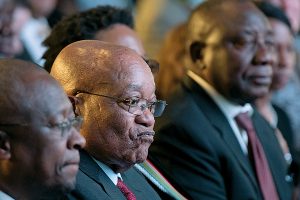
[caption id="attachment_32336" align="alignleft" width="300"] President Jacob Zuma’s African National Congress had its worst showing ever in elections in August, amid scandals and economic problems. HERMAN VERWEY/AP[/caption]
When Jacob Zuma, the man who would soon become South Africa’s president, told voters in 2008 that his party was essentially undefeatable, he spoke with earned bravado. His African National Congress (ANC) had already ruled South Africa for more than a decade and was on its way to a commanding victory in the following year’s national elections.
But when Mr. Zuma repeated that sentiment in July during the campaign for local government elections, it felt far more hollow. In the eight years since the president had first promised the ANC’s immortality, Zuma and his party had lurched from one crisis to the next – massive strikes, economic stagnation, diplomatic scandals, and corruption trials. Meanwhile, they had been squeezed from both the right and left by opposition parties bent on snatching away the votes of the black middle class as well as those of the ANC’s poor rural base.
And on a warm winter day in early August, South African voters responded to their president’s comment by delivering the ANC the worst electoral blow in its history. Support for the party plunged below 60 percent nationally for the first time as the party lost outright or fell below the 50 percent needed to govern in several major cities, including Johannesburg, Pretoria, and even the namesake of the ANC’s patriarch, Nelson Mandela Bay.
The impossible, it seemed, had suddenly become inevitable.
And it was not only South Africa that found itself on a political precipice this winter. In neighboring Zambia, a highly contested presidential election Aug. 11 saw the ruling party claw its way back to power by a strikingly narrow margin, sparking outrage from the opposition that is likely to far outlast the campaign itself. And next door in Zimbabwe, where the possibility of regime change by the ballot box has been off the table for decades, anger over the country’s tumbling economy and political mismanagement spilled into the streets, cracking open a door on a democratic process bottled up by the dictatorial, decades-long presidency of the 92-year-old Robert Mugabe.
Though none of the three countries has yet managed to unseat its powerful ruling party – and the factors that might lead to political change are hugely different in each – the agitation has put these governments on the back foot, and given them a bracing glimpse into what is possible in the months and years to come. For the world outside, too, they offer an instructive look at the spectrum of Southern Africa’s democratic possibilities a generation after liberation.
For South Africa in particular, the power of liberation politics seems to be irreversibly waning, replaced by a new generation of politicians, parties, and voters for whom the present reality of life in one of the world’s most unequal societies matters more than age-old loyalties to the freedom fighters of the past. But as South Africans step into that new era in their politics – rowdy, contentious, and profoundly uncertain – they may well glean important lessons from their neighbors to the north on how to fight the system from within (Zambia) and without (Zimbabwe).
A SPARK FROM ZIMBABWE
Southern Africa’s season of political protest began in Zimbabwe, back in April, with an inconspicuous video posted to Facebook by a pastor named Evan Mawarire. Draped in a Zimbabwean flag, Mr. Mawarire locked eyes with the camera for a four-minute speech that was equal parts spoken-word poem and political rallying cry.
“This is the time that a change must happen – quit standing on the sidelines and wishing for a future that you are not at all willing to get involved in,” he said. “This flag, every day that it flies, is begging for you to get involved; it’s begging for you to say something; it’s begging for you to cry out and say, why must we be in the situation that we’re in?”
Within a day, the video had had 120,000 hits. Within a few more, the hashtag #ThisFlag was trending in the country and across its diaspora, gathering steam as it collected the grievances of a country bruised by an economic meltdown and the worst drought in a half century. Three months later, with Mawarire’s support, the country’s public servants walked off the job after not being paid their June salaries, the pastor was arrested, and #ThisFlag hopped off the internet and onto the streets.
“For years the regime has held on through fear, but I think that time is over,” says Promise Mkwananzi, a political activist and one of the leaders of the recent protests. “Citizens are getting more and more bold and less and less scared.”
The protests – which continued into August – have been successful in part because their focus is not on the iron-fisted Mr. Mugabe, who has ruled the country uninterrupted since the end of white rule in 1980 and become expert in violently suppressing protest movements against him. The strength of the current protests, instead, has been that they avoided Mugabe altogether, issuing invective that seems at once nebulous – an end to “poverty, injustice, and corruption” – and pointedly narrow – the payment of salaries to civil servants, an end to a suffocating import ban.
“The campaign found great resonance among ordinary citizens from all walks of life because it was a clearly nonpartisan platform, unlike other recent polarized campaigns that were closely linked with opposition politics,” says Dewa Mavhinga, Human Rights Watch’s senior researcher for Zimbabwe and Southern Africa. “What was unique about Pastor Mawarire’s campaign was that it presented a broad-based nonpartisan platform through which citizens felt confident to criticize government on its poor human rights and economic record without feeling like political activists.”
Although Mugabe himself seems unflustered – in his 36 years of rule, after all, he has weathered many challenges – activists like Mr. Mkwananzi may have good reason to be hopeful. Some of Mugabe’s most muscular supporters, among them the Army and police, have been caught up in the salary crisis and are growing increasingly wobbly in their loyalty to the president. In July, for instance, a powerful group of veterans of Zimbabwe’s liberation struggle announced that they were defecting from the president’s ZANU-PF party, arguing that its dictatorial tendencies had slowly “devoured the values of the liberation struggle.”
But it will take more than a few pointed protests to unseat Mugabe, Mr. Mavhinga notes. “Perhaps [the #ThisFlag movement has] naively underestimated the repression capacity of the government,” he says.
ZAMBIANS GROW WEARY
For more than two decades, Zimbabweans have needed only to peek across their northern border to see how one of the continent’s most successful democracies functions.
Since Zambia became a multiparty state in 1991, its democracy has often been held up as a model for a region where political dynasties of the liberation era – South Africa’s ANC, Zimbabwe’s ZANU-PF, the Botswana Democratic Party – are common. But the country raised eyebrows in recent months when the run-up to its presidential election was blotted by scattered political violence and the shuttering of one of the leading opposition newspapers, The Post (allegedly for tax violations).
When incumbent Edgar Lungu was announced as the winner in the presidential race Aug. 15, securing just a sliver more than the 50 percent of votes needed to avoid a runoff, the opposition immediately cried foul, alleging vote rigging and promising to challenge the result in court.
But as Dimpho Motsamai, a senior researcher on Zambia at the Institute for Security Studies in South Africa, notes, the problem may be less the results of the election than the apathy it inspired from many quarters.
Just more than half of Zambian voters turned out in this campaign, and for many ordinary Zambians, she says, elections come and go with little effect on their lives.
“Elections have been equated to elite political power battles as opposed to avenues for change,” she says.
SOUTH AFRICAN CORRUPTION
If Zambians are growing wearier of pushing change through the ballot box, however, many South Africans seem to feel the opposite. Since the 1990s, much of the outside world has looked on the country’s fledgling democracy with a mix of expectation and foreboding. Here was Africa’s greatest hope – the rainbow nation of Nelson Mandela and Desmond Tutu, a country whose bright democratic future was built on strong institutions and a rowdy civil society. But here, too, were the coal-mine canaries of other failed African democracies – the former liberation movement with an increasingly unyielding grip on power, the leaders snatching from the public purse and stacking government agencies with their cronies.
“The romanticism of us being a liberation movement is being fast eroded by corruption in our ranks,” lamented Mathews Phosa, a former ANC treasurer-general, to journalists after the Aug. 3 elections. But if the country’s democracy looked messy, complicated, and wobbly, he said, at its core it was healthy. “The masses are punishing us with the weapon we won for them – the vote.”
Their votes, indeed, showcased the profound uncertainty that South Africans feel about their political future. Nationally, the ANC has lost control of nearly all major cities (the exception was its coastal stronghold, Durban). “There’s a gap between what the ANC is and what it needs to be for many voters,” says Aubrey Matshiqi, a political commentator and research fellow at the Helen Suzman Foundation, a Johannesburg-based think tank.
But the voters who unseated the ANC themselves remain profoundly divided.
So wide are the differences between the two leading opposition parties – the center-right Democratic Alliance and the populist left Economic Freedom Fighters – that the two refused to form coalitions that would have put them above the 50 percent needed to govern in several major cities, including Johannesburg.
Instead, the EFF begrudgingly agreed that it would vote for the DA’s mayoral candidates in several cities simply to stop the ANC from retaking power, but said it was not agreeing to collaborate with it beyond that point.
“The DA is the better devil,” EFF leader Julius Malema told reporters in Johannesburg Aug. 17. “We were caught between two devils.”
For many voters, however, the choice at the ballot box wasn’t so much between the ANC and its rivals as it was between the ANC and itself.
For Sifiso Ntuli, a Johannesburg restaurateur who spent the first decade of his adult life in exile fighting for the end of apartheid and the ascension of the ANC, the party is, above all, “an idea, one of the best ideas of the 20th century, in fact.” For him, he says, the party will always represent the inclusion and equality he grew up without. But after just over two decades of the ANC being in power, he says, that noble idea has been eclipsed by the humans – frail and imperfect – charged with carrying it forward.
“Think of it this way,” he says. “Our country is 22 years old. And like many 22-year-olds, it’s grown arrogant. It thinks it knows everything. This election is a reminder that when you’re 22, you still have a lot more to learn. You must be more humble.”
*CS Monitor.Mxolisi Ncube contributed to this report.