In South Africa, university protesters fight apartheid’s echoes
March 29, 2016
Universities here have become the epicenter of a forceful social reckoning led by a 'born free' post-apartheid generation disappointed with the country's direction.
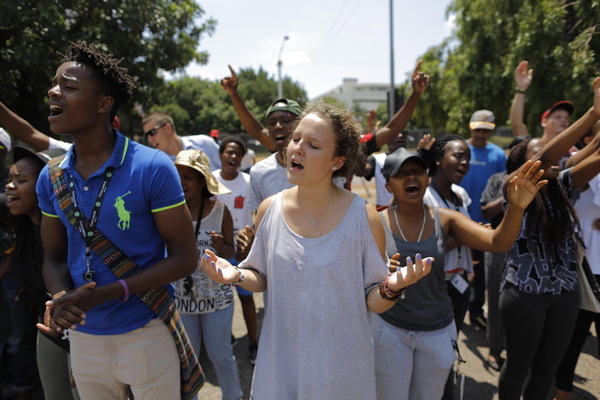
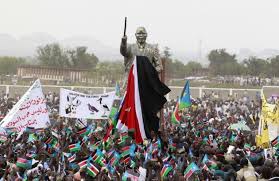
[caption id="attachment_27372" align="alignleft" width="600"] Some of the hundreds of young people gather during a mass, multi racial pray group, to pray for peace and calm after clashes at the University of Pretoria, Pretoria, South Africa, 25 February 2016. The campus was shut down after supporters of the EFF (Economic Freedom Fighters) clashed with members of the Afrikaans student community on 22 February over the EFF wanting to drop Afrikaans as the main language at the University of Pretoria. Universities through out the country are experiencing violent clashes during a five-month long student uprising. Kim Ludbrook/ Newscom[/caption] PRETORIA, SOUTH AFRICA — From the moment Karabo Mothapo stepped onto the leafy campus of the University of Pretoria (UP) more than three years ago, the place seemed to whisper a relentless message: You don’t belong here. He felt it as he walked to class through corridors lined with portraits of the university’s white benefactors. He heard it as he stumbled through his residence hall’s obligatory community song, which was sung in Afrikaans, a language he barely spoke. It was there, too, when he and his mother – a convenience store cook – scrambled to find ways to pay tuition fees not covered by his financial aid. When he looked around his lecture halls, Mr. Mothapo realized something startling: He probably had more in common with the people who cleaned them than the white students scribbling notes beside him. “You feel alienated,” he says of life at the university, which was a whites-only institution until the 1980s. “We have these symbols everywhere that convey to white students that this is their home, that they are represented and welcome here. Black students don’t have that, and over time it becomes incredibly demoralizing.” Mothapo’s experience speaks to a growing tension within South Africa’s universities. On the surface, campuses like his appear proof positive that the country’s dark history of racial exclusion is behind it. The students who fill the classrooms and lounge on the manicured quads are a well-proportioned rainbow of ethnicities and cultural backgrounds. And young people like Mothapo might well be the poster children for the new South Africa – ambitious and upwardly mobile, seemingly unencumbered by the racial hierarchies that so sharply delineated their parents’ life paths. But over the past year, those universities have become the epicenter of a forceful social reckoning led by those very same students – a rolling wave of protests that have contested everything from the continued prominence of colonial-era statues and colonial languages on campuses to the prohibitive cost of higher education and the low wages of university workers. It is a similar conversation being had at universities around the world, from Harvard to Oxford, where students are demanding that their schools abandon symbols and traditions that have connections to slavery or a colonialist history, sparking national conversations about the sluggish pace of institutional transformation. But in South Africa, the slate of those demands, at times, has been so expansive and emotional that the protests have seemed less a critique of the higher education system than an indictment of the state of the country itself. Two decades after the end of apartheid, student demonstrators say they are exhausted by the glacial pace of social change not only on their campuses but in their society as well – among the most unequal in the world. “Everything people are saying now, it concerns problems that have been left to linger for 22 years [since the end of apartheid],” says Mpho Mogadime, a law student at UP who participated in recent protests there. “Even if protests stop, how can we go back to normal? What is normal anymore? There is so much we still have to deal with.” That vast critique has resonated with many South Africans, but it has also created massive new tensions in the movement itself. In recent months, as protests have taken an increasingly militant turn, both students and their supporters have become starkly divided on a unified message and strategy. How the students go forward will have implications far beyond South Africa’s leafy campuses. Youth politics here hew closely to their adult counterparts, and students have frequently been at the forefront of social transformations. A protest legacy Student protest is a longstanding feature of campus life in South Africa, stretching far back into the apartheid era. Since the 1990s, students have used pickets and sit-ins to raise a variety of demands – for lower tuition, for more black professors, and for better wages for university workers. But last October, those diffuse and sporadic demonstrations briefly coalesced, rallying students at dozens of campuses behind a single slogan: Fees must fall. The faces of these protests against tuition hikes were young and black – members of the post-apartheid generation aspirationally known as the “born frees.” And for more than a week, the country watched in horror as they were pelted with rubber bullets and water from power hoses while being dragged crying into police cars. The images, for many, evoked the brutality visited against anti-apartheid protesters in an earlier era, and the students’ cause became so sympathetic that within 10 days it had done the unthinkable: winning over even the government it was demonstrating against. But even as President Jacob Zuma gave a televised address promising students that fees would not go up in 2016, police were using tear gas to disperse students gathered outside his office. And so the protests have ground on, becoming increasingly polarizing. A large number of campuses have had academic activities disrupted and even put on hold multiple times this year. At North-West University in Mafikeng in February, for instance, students torched several buildings during a demonstration against the dissolution of the student council, forcing the university to shut its doors indefinitely. And protesters at the University of Cape Town recently set alight a stack of paintings – mostly of white UCT benefactors – stripped from university walls during a protest over a lack of campus accommodation. Student activists, briefly the heroes of the nation, have now become lightning rods for controversy, leaving many older activists wringing their hands and university management pleading for compromise. “It is utterly regrettable that a movement that began with such promise and purports to be fighting for social justice matters has now deteriorated into a group that engages in criminality,” opined Max Price, the vice chancellor of UCT and himself a former student activist.
Two views
The protests, university leaders have argued, have become like an elaborate game of whack-a-mole – knock one issue away, and another immediately takes its place. “What is of concern is that we are seeing ... a rolling set of demands,” said Cheryl de la Rey, vice chancellor of UP, in late February. “Each time we think we have dealt with it and we move to [the] program of academics, then something new surfaces.” For students, that was always the point. “As long as there are injustices there will be protests,” Mothapo says. “I think this will continue for some time.” For him, these issues are deeply personal. The distance between the village where he grew up, in rural Limpopo Province, and UP is less than 200 miles, but the cultural space between them might better be measured in light-years. Until he entered university, Mothapo – a slight man with dreadlocks and an expansive smile – had never gone to school with a white person. At UP, however, nearly 40 percent of the student body was white, compared with less than 10 percent of the national population. Almost no one in his village owned a car. At UP, fellow students often griped about the difficulty of securing a campus parking space. But what alienated him most, he says, was the prominence of Afrikaans, the mother tongue of the earliest white settlers and the administrative language of the apartheid government. Afrikaans was the sole language of instruction at the university between the 1930s and the 1980s, when English-language options were introduced to accommodate the first racially diverse freshman classes. Today, campus signs are still printed in Afrikaans, and dormitories teach residents their traditional “house songs” – part of their initiation rituals – in the Dutch-based language. Though most of the student body opts for English, courses are offered in both languages. He couldn’t help feeling, Mothapo says, as though Afrikaans-speaking students were being given the chance to carve out their own cultural space on campus, while everyone else “was forced to assimilate.” The issue was deeply personal, too, to Marthinus Jacobs. Growing up, he was raised to see Afrikaans as more than a language. For his family it was a portal into their culture as Afrikaners. “It was about living an authentic Afrikaans cultural life and being proud of my heritage,” he says. When he arrived at UP to study veterinary science, that pride drew him to a student group called the AfriForum, which promoted Afrikaans language and culture on campus and fought for “minority rights” and against affirmative action policies that favored black students. “Our whole stance is that it doesn’t make sense to complain about inequality and being left out, and then go asking for the removal of a certain indigenous language from the curriculum,” he says. “Having Afrikaans here contributes to multilingualism at our university, and that can only be a good thing.” But not everyone was convinced. At a campus meeting in February to debate the university’s language policy, Mr. Jacobs and members of the AfriForum found themselves in a tense standoff with Mothapo and others from the campus chapter of the Economic Freedom Fighters, a South African opposition party. Who started the violence that followed depends on whom you ask, but the insults were barbed and the fight quickly turned physical. Phenyo Letlape, one of the black students present, heard AfriForum protesters chanting that black students should go home, using a harsh racial epithet that is local to South Africa. Jacobs, meanwhile, recalls black students taunting that they would chase the white Afrikaans supporters “back into the sea.” By the end of the day, university management announced that it was shutting the campus down until the situation could be resolved peacefully.
National barometer
A week later, the campus was still closed when a group of law students gathered in a nearby park to debate the merits of the protests and the university’s language policies. Most were black, some had protested themselves, and nearly all felt deeply uneasy about the growing chasms between students on campus. You were either for “transformation” – a post-apartheid buzzword – by any means necessary or you were against it completely. “I support the movement, but critically,” said Tom Karbey, a second-year law student who feared protesters could eventually alienate everyone who might be able to help them change the status quo – not least of all university management. “But ultimately I think it would be a mistake to stigmatize these protests or to stop listening to them, because what they’re showing us is that something is really wrong here, and people no longer feel they have another choice.” In that way, South Africa’s student protests hold a mirror to the country, which many analysts believe has seen a sharp increase in antigovernment protest actions since 2010. Like demonstrations on campus, these protests have been diffuse and personal, less a coordinated movement than a generalized barometer of the rising disconnect between the country’s political elite and its citizens. Public satisfaction with the country’s young democracy has recently fallen to below half the population, according to a 2015 Afrobarometer survey, and 61 percent now say they would be willing to forgo elections if safety, rule of law, housing, and jobs could be guaranteed instead. With the ruling African National Congress embroiled in a seemingly endless parade of scandals over cronyism and corruption, and opposition parties still too weak to challenge their 22-year rule, many see little choice but to take their discontent to the streets. But university students have one distinct advantage over other South African protesters. They are young and educated, a future political elite in the making. Some of the most visible protesters in recent months have been the children of current business and government titans. That makes their uprising more visible, more pressing, and more alarming to those in the halls of power. As Songezo Zibi, then the editor of South Africa’s leading financial newspaper, Business Day, wrote last year, many are now watching the students to understand where the country will go next. “Once again ... it was left to the young to fight for something dear to their future in a way that shows the rest of the country and the world what is broken about our politics,” he wrote. “They have provided a powerful lesson in what the next few years may look like now that a new standard in the exercise of the right to free assembly and protest has been set.” *Source Christian Science Monitor