
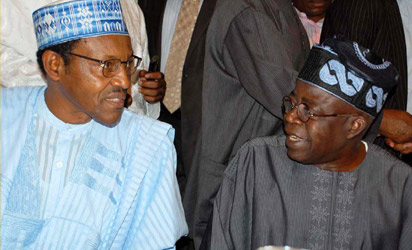
 Buhari with Tinubu[/caption] Except that there were other accounts. Citibank has a worldwide banking division known as Citibank International where Tinubu stashed an additional $550,000. He also controlled an entity called Compass Finance and Investments Company Ltd., of which Akande and Agbele were directors. Still another nexus of money transfers was uncovered by federal investigators, with cash moving from First Heritage to Citibank to Citibank International, where it wound up in Tinubu’s personal accounts and in those belonging to Compass Finance and Investments. In a follow-up exchange with law enforcement officers, Tinubu changed his story. Just days after conceding that he’d sent and received money to and from Akande, he insisted that he had no financial or business dealings with Akande or Agbele. There’s no evidence that Tinubu was ever indicted for any crime. He eventually settled with the district court, turning over $460,000 of the seized $1.4 million, with the remainder released back to him. The Beast tried repeatedly to contact Marsha McClellan, the U.S. attorney who prosecuted the case, but was unsuccessful. “I’m not surprised at all,” said Virginia Comolli, a specialist on Nigeria and author of Boko Haram: Nigeria’s Islamist Insurgency. “There’s a trend of various Nigerian politicians at the highest levels involved in dodgy business deals around the world, in property and cash. Even ones who seem fairly clean turn out to have some dark histories.” The perfect case in point is Tinubu’s political project and new president-elect of Nigeria, General Muhammed Buhari, who in 1983 helped overthrow a democratically elected government in a military coup d’etat on the grounds that the government was undisciplined and corrupt. “He resorted to brutal methods, beating up people for not queuing properly and imposing limitations on the media,” Comolli said. “I think a lot of the votes Buhari got were anti-Jonathan rather than pro-Buhari.” But no doubt, many also came from a savvy fusion of political factions. In February 2013, Tinubu successfully merged his own influential Action Congress party with Buhari’s Congress for Progressive Change, resulting in the All Progressives Congress. The marriage united Nigeria’s most populous northwest and southwest regions and the ensuing campaign was billed by Tinubu as a “commonsense revolution” against a corrupt and venal incumbency which, in its five years in power, had seen the terrorist group and newly-minted ISIS affiliate Boko Haram thrive. Buhari swept the election with 2.7 million more votes than Jonathan. Even before that trouncing, however, Tinubu had a relatively positive reputation in Nigeria, according to former U.S. ambassador to Nigeria John Campbell. “He is widely regarded as having been a highly successful governor of Lagos state,” he said. “Together with Tinubu’s handpicked successor, Babatunde Fashola, Lagos has seen dramatic improvements in everything from practical stuff like garbage collection to the collection of taxes and the provision of public services,” Campbell told The Beast. Though even here, the ex-diplomat admits, Tinubu’s good governance has been clouded by controversy. “He established a company to do the tax collecting in return for a cut and, at one point, Tinubu and Fashola appeared to be splitting over the percentage of Tinubu’s cut.” Drug charges do indeed appear to be the sine qua non for Nigerian high office. The year 1993, when Tinubu’s assets were seized, was a turbulent period for Nigeria following the cancellation of a national election and the establishment of a military dictatorship. Moshood Abiola, the rightful winner of that election, was accused of narcotics trafficking according to Campbell. So too is “Prince” Buruji Kashamu from the People’s Democratic Party, who has faced extradition back to the United States since 1998. Kashamu was indicted by a federal grand jury in Chicago for being the elusive “Alaji,” a globetrotting drug kingpin who smuggled heroin into O’Hare International Airport from Europe and Asia. Piper Kerman, the memoirist who inspired the Netflix series Orange is the New Black, famously worked for Alaji. Kashamu denies the charges and insists that he was purportedly a counterterrorism informant to the U.S. government before and after 9/11, and that the real trafficker was his now-deceased brother. Despite his party’s general loss to the All Progressives Congress, Kashumu was elected in March as senator of the southwest Ogun state. In what appeared to be a magnanimous gesture to the winner, he took out an advertisement praising Tinubu as a role model. The Jagaban was distinctly unimpressed. He trashed the comparison in a statement signed by his media adviser, claiming that for Kashamu “to liken himself to Bola Tinubu is for a small rut to call itself a mountain.” Tinubu instructed the “false praise singer” to go face the music in the Windy City before deigning to talk to him. *Source Daily Beast Buhari with Tinubu[/caption] Except that there were other accounts. Citibank has a worldwide banking division known as Citibank International where Tinubu stashed an additional $550,000. He also controlled an entity called Compass Finance and Investments Company Ltd., of which Akande and Agbele were directors. Still another nexus of money transfers was uncovered by federal investigators, with cash moving from First Heritage to Citibank to Citibank International, where it wound up in Tinubu’s personal accounts and in those belonging to Compass Finance and Investments. In a follow-up exchange with law enforcement officers, Tinubu changed his story. Just days after conceding that he’d sent and received money to and from Akande, he insisted that he had no financial or business dealings with Akande or Agbele. There’s no evidence that Tinubu was ever indicted for any crime. He eventually settled with the district court, turning over $460,000 of the seized $1.4 million, with the remainder released back to him. The Beast tried repeatedly to contact Marsha McClellan, the U.S. attorney who prosecuted the case, but was unsuccessful. “I’m not surprised at all,” said Virginia Comolli, a specialist on Nigeria and author of Boko Haram: Nigeria’s Islamist Insurgency. “There’s a trend of various Nigerian politicians at the highest levels involved in dodgy business deals around the world, in property and cash. Even ones who seem fairly clean turn out to have some dark histories.” The perfect case in point is Tinubu’s political project and new president-elect of Nigeria, General Muhammed Buhari, who in 1983 helped overthrow a democratically elected government in a military coup d’etat on the grounds that the government was undisciplined and corrupt. “He resorted to brutal methods, beating up people for not queuing properly and imposing limitations on the media,” Comolli said. “I think a lot of the votes Buhari got were anti-Jonathan rather than pro-Buhari.” But no doubt, many also came from a savvy fusion of political factions. In February 2013, Tinubu successfully merged his own influential Action Congress party with Buhari’s Congress for Progressive Change, resulting in the All Progressives Congress. The marriage united Nigeria’s most populous northwest and southwest regions and the ensuing campaign was billed by Tinubu as a “commonsense revolution” against a corrupt and venal incumbency which, in its five years in power, had seen the terrorist group and newly-minted ISIS affiliate Boko Haram thrive. Buhari swept the election with 2.7 million more votes than Jonathan. Even before that trouncing, however, Tinubu had a relatively positive reputation in Nigeria, according to former U.S. ambassador to Nigeria John Campbell. “He is widely regarded as having been a highly successful governor of Lagos state,” he said. “Together with Tinubu’s handpicked successor, Babatunde Fashola, Lagos has seen dramatic improvements in everything from practical stuff like garbage collection to the collection of taxes and the provision of public services,” Campbell told The Beast. Though even here, the ex-diplomat admits, Tinubu’s good governance has been clouded by controversy. “He established a company to do the tax collecting in return for a cut and, at one point, Tinubu and Fashola appeared to be splitting over the percentage of Tinubu’s cut.” Drug charges do indeed appear to be the sine qua non for Nigerian high office. The year 1993, when Tinubu’s assets were seized, was a turbulent period for Nigeria following the cancellation of a national election and the establishment of a military dictatorship. Moshood Abiola, the rightful winner of that election, was accused of narcotics trafficking according to Campbell. So too is “Prince” Buruji Kashamu from the People’s Democratic Party, who has faced extradition back to the United States since 1998. Kashamu was indicted by a federal grand jury in Chicago for being the elusive “Alaji,” a globetrotting drug kingpin who smuggled heroin into O’Hare International Airport from Europe and Asia. Piper Kerman, the memoirist who inspired the Netflix series Orange is the New Black, famously worked for Alaji. Kashamu denies the charges and insists that he was purportedly a counterterrorism informant to the U.S. government before and after 9/11, and that the real trafficker was his now-deceased brother. Despite his party’s general loss to the All Progressives Congress, Kashumu was elected in March as senator of the southwest Ogun state. In what appeared to be a magnanimous gesture to the winner, he took out an advertisement praising Tinubu as a role model. The Jagaban was distinctly unimpressed. He trashed the comparison in a statement signed by his media adviser, claiming that for Kashamu “to liken himself to Bola Tinubu is for a small rut to call itself a mountain.” Tinubu instructed the “false praise singer” to go face the music in the Windy City before deigning to talk to him. *Source Daily Beast