Angola's economy grows, but what about the poor?
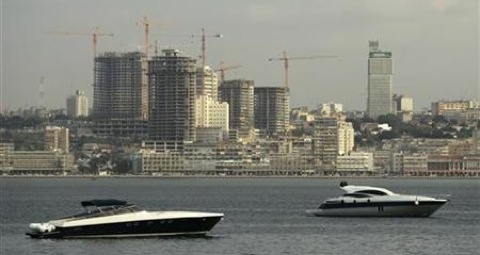
October 18, 2014 Nirit Ben-Ari* [caption id="attachment_13054" align="alignleft" width="480"] ANGOLA'S CAPITAL, LUANDA. PHOTO©REUTERS[/caption] Although Angola's economy grew by 5.1 percent in 2013, making the Southern African country one of the world's fastest growing economies, ordinary Angolans have seen little change in their standard of living. As major public infrastructure investments in energy and transport kick in, Angloa's growth is projected to reach 7.9% in 2014 and 8.8% in 2015. Yet, the United Nations Development Programme (UNDP) reports that around 36% of Angolans live below the poverty line and one in every four people is unemployed. According to the International Monetary Fund (IMF), Angola is a "post conflict country that produces a lot of oil and faces the challenges of both." Despite being the fifth largest economy in Africa, ordinary Angolans have seen little change in their standard of living. Only 37.8% of country's 21 million people have access to electricity. While about half of the population has access to safe drinking water, this number falls to 34% in rural areas, says the World Bank. There are few jobs for the unemployed, mostly under 25 years, who make up 60% of the population. What should Angola do to change the current situation? Analysts say the solution is for Angola to diversify its economy, save and invest for the future -- especially in skills and infrastructure development -- and improve governance. A need for diversification Angola is Africa's second biggest oil producer after Nigeria. Its oil comes almost entirely from offshore fields, off the coast of Cabinda and from deep-water fields in the Lower Congo basin, in addition to small-scale production from onshore fields. Last year, according to the US Energy Information Administration, an agency that provides statistics and analyses on energy, Angola produced 1.85 million barrels of petroleum per day, and oil revenues could top $60 billion this year, notes the African Economic Outlook, a report produced jointly by the African Development Bank, the Organization for Economic Co-operation and Development, the United Nations Development Programme and the United Nations Economic Commission for Africa. But as with other oil-producing countries in Africa, oil has not proved to be a benefit to Angolans. If anything, say analysts, it has produced few jobs, increased inequality and allegations of corruption. Angola's mineral product exports as a share of total exports is more than 95%, according to data from the World Bank and the Organization of the Petroleum Exporting Countries (OPEC). Oil production and its supporting activities contribute about 45% to the nation's gross domestic product (GDP) and 80% to government revenues. With little diversification, the Angolan economy has limited investment and job opportunities, and generates growth only for a small group of elites, economists say. In fact, in terms of the composition of its exports, Angola is the world's second most concentrated economy after Iraq, says the UNDP. The World Bank has identified three problems facing the Angolan economy: high dependence on oil revenue, making the country vulnerable to oil price volatility; an economic system that is prone to corruption; and the absence of a diversified job market. The British magazine, The Economist, reported last April that Angola was "still much too oily," because oil provides few jobs, especially good jobs, and according to the government's own admission, there has been a "failure to develop the non-oil economy." The oil industry employs just 1% of Angolan workers, which is a factor in the 26% unemployment rate. The Center for Scientific Studies and Research (CEIC) at the Catholic University of Angola, by contrast, sees the oil-dominated economy expanding substantially since independence, particularly since the end of the civil war in 2002. While conceding that diversification was largely absent from government policy until 2011, the CEIC says that other sectors are now contributing to the GDP, though not substantially. Agriculture is a lifeline In addition to oil, Angola exports diamonds. It is Africa's second largest source of rough diamonds after Botswana and the fourth in the world. The main reserves are concentrated in the north-eastern region. Diamond production generates over $650 million annually, although exact numbers are uncertain due to illegal diamond mining and smuggling. The diamond mining industry is a significant source for foreign revenue for the country. In 2003, Angola sold between 5,3 Mct (million carats) and 6 Mct worth of diamonds, at a value of about US$1 billion, through the state-owned Sociedade de Comercializacao de Diamantes de Angola (Sodiam). But the diamond industry is often alleged to be involved in human right abuses, such as forced overtime without adequate compensation and creating environmental degradation through mining activities. Rafael Marques de Morais, an Angolan journalist, human rights activist and anti-corruption campaigner, recently filed a criminal complaint against two diamond mining companies and their directors, including top military officers. In response, authorities labelled him an "official suspect" and officials from some mining companies have accused him of defamation. Isabel dos Santos, the billionaire daughter of the Angolan president, is said to be one of the main beneficiaries of the diamond trade in Angola, according to an article this year in Forbes business magazine. Besides oil, other contributors to GDP include non-oil energy, agriculture, fisheries, manufacturing and construction sectors. Angola has high quality soil and good water supplies, which potentially could make commercial farming a valuable industry, according to the African Development Bank (AfDB). Currently, agriculture accounts for only 11% of GDP but 70% of total employment. In 2013, farm output grew by 8.6%, mostly through strong growth in cereal production, notes the African Economic Outlook. The National Cereals Institute of Angola says that the country requires 4.5 million tonnes of grain a year but only grows about 55% of the corn, 20% of the rice and just 5% of the wheat needed for local consumption. Higher government spending on agriculture could change that and make Angola self-sufficient, suggests the Food and Agriculture Organization, the UN body that mobilizes efforts to eradicate hunger and poverty. However, overall, Angola's agricultural sector is growing impressively. The Comprehensive African Agriculture Development Programme (CAADP), an initiative of the African Union, reported in 2011 that the sector grew at more than 25%, surpassing the 6% target set for African countries. That growth rate made Angola's agriculture the fastest growing on the continent, followed by Namibia's at 15% growth rate. More expatriate workers Angola has also become a magnet to economic refugees from China and Portugal. "Definitely more Portuguese people are coming here in recent years, not only because of the bad financial situation in Europe but because Angola is one of the fastest-growing economies in the world," observes Ribeiro, a Portuguese national who runs a pizzeria in Luanda. They are joining an influx that includes Chinese, Brazilian and, to a lesser extent, British investors. "We've always been one of the biggest communities, but we're slowly being surpassed by the Chinese," Mr. Ribeiro, 52, told The Guardian, a British daily. "The Chinese are very resilient people and are prepared to do the donkey work that Portuguese and Angolans are not." Portuguese engineers, for example, may make €900 per month in Portugal, but they make four times more in Angola, reported the British Broadcasting Corporation (BBC). As a consequence of this reverse population flow, Luanda, Angola's capital, "has overtaken Tokyo as the world's most expensive city to live in for expatriates," according to the American news channel, CNN. Chinese investors are heavily involved in Angola's large-scale public works such as roads, rails, and other infrastructure. But critics say these investors do not create sufficient jobs because they bring most of their workers from China. In 2008 alone, the Angolan consulate in China issued more than forty thousand visas to Chinese workers, reports the bimonthly global affairs journal, World Affairs. The China International Trust and Investment Corporation employed 12,000 Chinese workers and only a handful of Angolans during the peak of the Kilamba Kiaxo social housing development project in Luanda. In addition, the journal states that while the majority of Chinese in Angola work in the construction sector, thousands later branch out into real estate, retail, street hawking, etc. Future prospects In 2013 the Angolan economy weakened because of lower-than-expected oil spending and mismanagement of the public debt. But the AEO report predicts that with increasing diversification, the non-oil sector could expand by 9.7% and the oil sector by 4.5% in 2014. Worried about the uneasiness among its population over growing inequality amid rapidly rising economic growth, the government is now taking steps to improve the lives of its citizens. There are ongoing investments in electricity, water and transport. As part of the infrastructure-for-oil trade agreement between China and Angola, rail infrastructure is expanding. To create more jobs, the government has introduced a new foreign exchange currency law for the oil industry and reformed the regulations governing the mining sector. Introduced in November 2012, the law also cuts business taxes from 35% to 25%, which in return has led to significant investments by companies including diamond producers De Beers and Sumitomo Corp. Both companies are currently developing an ammonia and urea plant. This year, Angola's central bank plans to de-dollarize the foreign exchange market to limit the use of foreign currency in local transactions. In the past, most oil receipts were conducted offshore; the new laws require transactions to be handled onshore. But Angola needs more sound policies to attract investors to all sectors, not just diamonds and oil, experts say. Currently, the World Bank's "Ease of Doing Business" report ranks Angola 179 out of 189 countries. This low ranking has to change for the economy to live up to the expectations of its 21 million people. *Source theafricareport.Nirit Ben-Ari writes for United Nations Africa Renewal Magazine ]]>