From rising star to almost basket case: Tough lessons for Kenya from Ghana
September 01, 2014
By DAVID NDII*
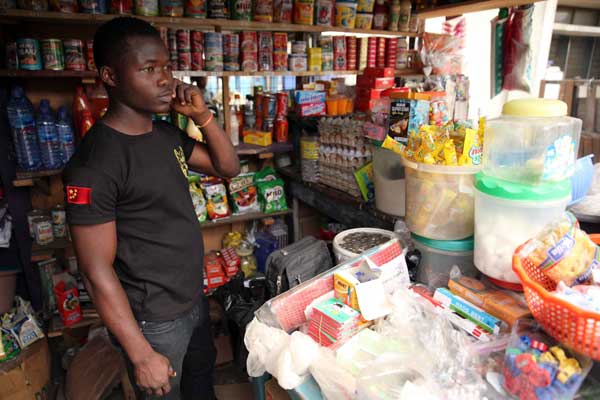
[caption id="attachment_11532" align="alignleft" width="600"] Kingsley Adukpo stands in his shop in Accra on February 11, 2014. Adukpo had to repeatedly raise his prices due to the weakening Cedi (Ghanaian currency). Ghana’s trade balance has worsened. The current account deficit has risen from an average of eight per cent of GDP before it started exporting oil to 13 per cent last year. AFP PHOTO | CHRIS STEIN[/caption] The wheels are coming off Ghana’s economic miracle. The cedi has fallen 40 per cent this year. Interest rates have gone through the roof. Inflation is at 15 per cent and rising. Landlords are demanding rent in dollars.
Last week Ghana applied for IMF assistance to deal with its macroeconomic crisis.
Ghana is one of the brightest stars of the “Africa Rising” story. Ghana has sustained economic growth over six per cent for more than a decade, propelling it to attain the coveted middle income status.
Oil was discovered in 2007 and came on stream in 2010 adding to gold, of which Ghana is Africa’s largest exporter. Ghana is also the world’s second largest exporter of cocoa after neighbouring Cote d’Ivoire.
Unsurprisingly, Ghana led Africa in tapping the international capital markets issued first Eurobond in 2007 and a second one last year.
Ghana’s oil production started in 2010, and is running at about 80,000 barrels a day. Ghana’s trade balance has worsened. The current account deficit (the difference between foreign exchange earnings and expenditure) has risen from an average of eight per cent of GDP before it started exporting oil to 9 per cent in 2011, 12 per cent in 2012 and 13 per cent last year.
Ghana’s management of its public finances was never great to begin with. However, following the discovery of oil, the Ghanaian state seems to have opened the floodgates. Government expenditure has ballooned from 20 per cent to 27 per cent of GDP in the last two years, against revenues of 20 per cent of GDP.
ARREARS OF ALL SORTS
In addition to two Eurobonds totalling $1.5 billion, Ghana took a highly controversial US$ 3 billion loan from the China Development Bank, secured on oil. Between these and other borrowings, Ghana has managed to double her foreign debt in three years.
Ghanaians are intrigued as to where all the money is going. The government is building arrears of all sorts including statutory payments to their NHIF and road maintenance fund. Contractors are going unpaid for months on end. Recently, Government cheques bounced.
One of the holes that Ghana’s money has been disappearing into is judgement debts — of the sort that we recently paid for Anglo Leasing.
One Ghanaian newspaper columnist described them as follows: “Government demolishes houses to make way for a road construction. Compensation is paid to affected persons. Someone who was unaffected puts in a claim for compensation. The state agency responsible declines his request. He goes to court to seek judgement debt. Government puts in no defence. A default judgement is awarded. Months later, hundreds of thousands of Ghana cedis is paid to him. Unchallenged.” Sounds familiar?
In August 2012, the president, the late John Atta Mills, admitted that his Government had paid equivalent of Sh28 billion in judgement debts. After intense public pressure, the current president set up a commission of inquiry, the Judgement Debt Commission, to investigate these payments. Sometimes last year, the commission’s offices burned down.
Oil, Eurobonds, Chinese loans, judgement debts, hubris…can we go the same route as Ghana?
DEFICIT STILL RISING
The numbers speak for themselves, and pictures, as they say, speak louder than words. Chart 1 shows the evolution of the budget deficit over the last decade or so. The data is presented differently from the way the government reports it.
The government reports it on a discrete fiscal year basis. Here I present the data on a continuous month-on month basis, that is, every monthly data point is the total for the preceding twelve months (that’s January 2010 to December 2011, February 2011 to January 2012, March 2011 to February 2012 and so on).
This way, we are able to see the actual trend over the long haul. What do we see?
GRAPHIC | DAVID NDII
It’s not pretty. During the first three years of Narc regime, we are running a deficit in the order of Sh50 billion a year, 14 per cent of total expenditure on average.
We even run a budget surplus for most of 2006/7 financial year. The deficit escalated to Sh100 billion in 2008, rising to Sh200 billion by 2010. This was the effect of the fiscal stimulus introduced to respond to multiple economic shocks, namely post-election violence, drought and the global financial crisis.
The deficit went down in 2011, as the economic stimulus spending ended, but that did not last, as it escalated sharply in 2012. I have not dug into this escalation but I suspect it has a lot to do with war in Somalia and Kibaki legacy projects.
But the most startling development is what has happened since the Jubilee Government took office. From April to June 2013, the deficit escalates by Sh136 billion. By May this year, it is running at Sh460 billion, more than double what it was when Jubilee took over in April 2013.
In relative terms, the budget deficit averaged 3.5 per cent of government expenditure during the first Kibaki administration, rising to an average of 19 per cent during the Grand Coalition administration.
It has averaged 29 per cent during Jubilee’s first year, and it’s still rising. What is the Jubilee Government doing with money? I have no idea.
Chart two shows the debt situation. It’s not pretty either. During the Grand Coalition administration our debt increased by Sh200 billion a year on average.
GRAPHIC | DAVID NDII
The largest increase was by Sh300 billion in the 2010/11 financial year. The published data shows that we increased our debt by Sh475 billion last financial year. However, the published data includes the proceeds of the Eurobond, but does not include the Chinese loan for the railway, reported to be $3.2 billion (Sh280 billion).
BORROWING TO PAY
When we add this, the debt increase for the year is Sh750 billion. The Grand Coalition increased our debt by Sh1,000 billion (one trillion) in five years. The Jubilee Government has done three quarters of that in one year.
It does not require a whole lot of economic expertise to see that these trends are unsustainable. And we will soon be piling on more debt to finance LAPPSET and the 5000 MW power initiative among other mega projects. We are, without doubt, hurtling towards a macroeconomic crunch.
According to the reported terms, we have signed two Chinese loans for the railway, one for 12 years with a five-year grace period and the other for 20 years with a seven-year grace. This means in five years, we will start paying the first, and two years later, we start paying the second. The principal on the first loan works out to $230 million (Sh20 billion) per year.
The repayment of this will coincide with the maturity of the five-year Eurobond which is $500 million (Sh43.5 billion). This means we will have to set aside an extra $730 million, or Sh44 billion at current exchange rate. This is about how much we spent servicing all our foreign debt last financial year.
It is obviously very difficult for a government to set aside such a huge amount of money from one year to the next. The normal way that government’s finance this is by refinancing, which is fig leaf lingo for borrowing to pay. We need to pray that the financial markets will still have an appetite for African sovereign debt.
PROSPECTS OF DEFAULT
The week before turning to the IMF, the finance minister had announced that Ghana was preparing to go back to the market for another $1.5 billion. Even then, Ghana was looking at paying nine per cent interest on the issue — about how much I pay for dollar denominated loans in the local market.
That is now going to be a hard sell, although it has no choice but to go back to the market with IMF backing, otherwise its currency will continue sliding and increase prospects of default.
Ghana is not alone in dampening the enthusiasm for African sovereign Eurobonds. Macroeconomic distress is also stalking Zambia. After the record subscription of Zambia’s debut bond, yields have risen steadily, losing the initial subscribers a fair amount of money (a rise in bond yields has the same effect as a fall in the price of a share).
It is not inconceivable that the appetite for African sovereign bond issues will wane as more African countries, us included, abuse their newly found financial freedom.
Whatever the case, we cannot afford to continue on the fiscal path that we are on. It is reckless. This mega-infrastructure madness has to stop.
If we don’t do it ourselves, the iron laws of economics will do it for us—and that, take it from me, does not come cheap.
*Source nation David Ndii is the Managing Director of Africa Economics. ndii@netsolafrica.com

 GRAPHIC | DAVID NDII
  GRAPHIC | DAVID NDII