9 questions about South Sudan you were too embarrassed to ask
January 01, 2014
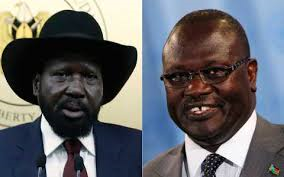
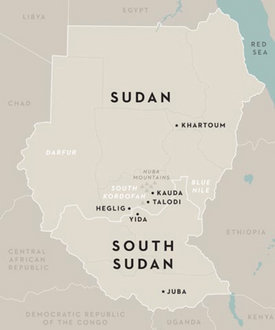
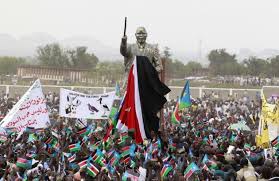
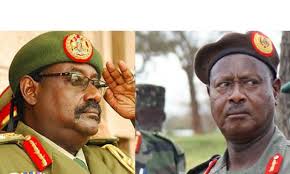
Max Fisher* [caption id="attachment_7794" align="alignleft" width="284"] Friends turn Foes:President Salva and former Vice President Machir[/caption] South Sudan's crisis began just two weeks ago, on Dec. 15, and it already has observers warning that it could lead to civil war. Fighting has killed an estimated 1,000 people and sent 121,600 fleeing from their homes. International peacekeepers are preparing for the worst; some have been killed and a number of them, including four U.S. troops, have been injured. What's happening in South Sudan is complicated and can be difficult to follow; understanding how it got to be this way can be even tougher. Here, then, are the most basic answers to your most basic questions. First, a disclaimer: This is not an exhaustive or definitive account of South Sudan and its history -- just some background, written so that anyone can understand it. 1. What is South Sudan? South Sudan is the world's newest country. It's located in Central Africa, is about the size of Texas and has about as many people as Ohio (11 million). South Sudan is one of the poorest countries in the world, has a 27 percent literacy rate and is so underdeveloped that it has only about 35 miles of paved road. Its economy is driven by oil exports. South Sudan declared independence from the rest of Sudan on July 9, 2011. At the time, it was considered a huge success for the world. But its 2½ years as a sovereign state have been disastrous. This latest crisis is just another part of the country's struggle to stand on its own. 2. Why are people in South Sudan killing each other? The violence started on Dec. 15, when troops in the presidential guard started fighting against one another, in what is a depressingly accurate metaphor for South Sudan's problems. That fighting quickly spread and is now engulfing entire swaths of the country. If that seems like a strange way for a potential civil war to start, it will make more sense once you hear the backstory. In July, the president of South Sudan, Salva Kiir, fired his vice president, Riek Machar. The two were more rivals than partners; Kiir thought that Machar was gunning for his job. Here's the really important thing: Kiir and Machar are from different ethnic groups, and in South Sudan ethnic groups are really important. Kiir is ethnic Dinka, the largest of South Sudan's many ethnic groups. Machar is Nuer, the country's second-largest group. Tension between the Dinka and the Nuer goes way back in South Sudan, and the political rivalry between the groups' two most powerful members, Kiir and Machar, always had the potential to become an ethnic conflict. It did on Dec. 15, when members of the presidential guard who are Dinka tried to disarm members of the guard who are Nuer, maybe because they feared the Nuer would try to stage a coup. (Kiir later said the fighting had started because Machar had tried to stage a coup, although evidence for this is thin.) The fighting between Dinka and Nuer presidential guards very quickly spread across the country. The main antagonists are rebels, often ethnic Nuer, including a group called the White Army. (Some reports say the group got its name because fighters smeared themselves with white ash to protect themselves from insects.) The rebels have seized territory, including some oil-producing land, and may or may not be marching on the city of Bor. 3. How could that one little incident spark such a big conflict? When fighting spread from a few presidential guards to entire areas of South Sudan, we saw something that has happened before in sub-Saharan Africa. Political leaders and grass-roots militants alike defaulted from their national identity to their ethnic identity. Political rivalries became ethnic conflicts. Competing against the other group became more attractive than cooperating. Since they won independence, it's been hard for South Sudan's ethnic groups to get along. Southerners don't have that common enemy uniting them anymore. Worse, they don't have a strong sense of belonging to a shared nation. People have been identifying by ethnicity for so long that they often still do. Another big problem is that South Sudan is extremely poor but has lots of oil; that makes it very tempting for ethnic groups to compete for the scarce resources they so badly need. If this were, say, Iceland, then a contentious rivalry between the nation's two leading politicians would probably be seen as just political infighting, or at most perhaps a clashing of political parties or ideologies. But Kiir and Machar are the two most powerful people from their ethnic groups in a country where ethnic grouping is very important. So a fight between those two men was bound to exacerbate tension between their respective ethnic groups, which also have lots of other people in positions of power. And they have militias. 4. I thought giving South Sudan independence was supposed to stop ethnic fighting. Why didn't it? The tragedy of South Sudan is that the same forces that helped it win independence also set it up for this conflict. People in southern Sudan spent decades fighting for autonomy from the north. This led them to organize themselves by their tribe or ethnicity, since they had no national identity to align with. It also led them to form militias. Those militias, sometimes organized by tribe or ethnicity, came together as the Sudan People's Liberation Movement (SPLM). The SPLM has since become South Sudan's national army. When the south's ethnic groups were fighting on the same side, against the north, they mostly got along okay. But, in 1991, the SPLM split along ethnic lines. Some fighters who were ethnic Nuer formed their own semi-official breakaway group, the White Army, which attacked Dinka civilians in the city of Bor, killing 2,000. That fighting stopped, but the White Army has stuck around, in part because some Nuer fear they will not be treated fairly by the Dinka, who are more numerous and who hold the country's presidency. Today, rebels took up arms in the apparent belief that Kiir's government was turning against the Nuer, and perhaps also because they saw Kiir going after Machar, who does not lead the White Army but has long been associated with it. Remember that many Nuer split off from the SPLM in 1991; while they've since reconciled, the SPLM is officially commanded by Kiir, who is Dinka. And Kiir has called Machar, the country's most important Nuer, a traitor. It was almost inevitable that when Kiir turned against Machar many Nuer would think that he was seeking to marginalize their entire tribe. That's how the political fight could turning into an ethnic conflict. 5. This is all very intense. Let's take a music break? Good idea. Since we're focusing so much on South Sudan's problems since independence, let's listen to this song by South Sudanese pop singer Queen Zee from late 2010, "Referendum," encouraging people to vote in the January 2011 election for independence. The song helps capture the degree to which the vote brought the South Sudanese together, even if that unity has been hard to maintain, and the excitement the election brought. 6. How did South Sudan become independent, anyway? This question, and to some extent the conflict itself, goes back to European colonialism and the artificial borders it imposed on Africans. As the British expanded across the continent, in the 1890s they began incorporating Sudan into the empire. In part to prevent neighboring Egypt from claiming northern Sudan as its own, the British lumped the Sudan's north and south together. The two parts of the country are very different, though: The north is mostly Arab and Muslim, while the south is made up of ethnic sub-Saharan Africans who are Christian or Animist. When colonialism ended and Sudan declared independence in 1956, it kept its unwieldy colonial borders, with the capital Khartoum in the Arab-Muslim north. You can guess what happened next: The northern-dominated government treated the black-skinned southerners badly; southerners formed militias; and then came the civil wars. Yes, wars, plural: The first began in 1955, before Sudan even declared independence, and ended in 1972 with greater autonomy for the south. The second civil war started in 1983, when the government in Khartoum revoked much of the south's autonomy and southerners formed rebel groups to fight the north. The second civil war finally ended in 2005 – the longest-running conflict in Africa – with a peace accord that promised the south it could hold a referendum for independence. In early 2011, 98.8 percent of southern voters said they wanted to secede from the north, and a few months later they got it. There were two important outside factors that made independence happen. First, the United States played a key role supporting the south's demand for independence (more on this later). Second, the Sudanese government was loathed by much of the world for its human rights abuses and its affiliation with terrorist groups; this made it easier to build international pressure against Khartoum. 7. I remember South Sudan's independence being treated as a huge success. Was that not true? Yes, it was a big success, promising southern Sudanese a reprieve from decades of war and the autonomy they'd long desired. It went peacefully enough, which was great, and it seemed like a promising sign for the world's ability to resolve terrible conflicts. But things have really gone south since then. South Sudan endured violent ethnic conflicts (sometimes with the South Sudanese government part of the problem), fought a brief war with Khartoum in which South Sudan was far from blameless and even briefly shut off oil production to punish the north. In May 2012, less than a year after it had helped establish South Sudan as an independent country, the United Nations threatened it with economic sanctions for its bad behavior. South Sudan's government, meanwhile, has been plagued by infighting and widespread allegations of official corruption. Poverty and poor governance are big problems for South Sudan. But the biggest of all may be the fact that the country has never really resolved its ethnic rivalries. Until this most-basic problem can be solved, there will always be the possibility for another conflict. 8. What does this all have to do with Darfur? Anything? On the surface, not really. Darfur is a part of the Republic of Sudan, not South Sudan, and so is not involved in South Sudan's conflict. But the Darfur conflict that killed so many civilians in the mid-2000s, and which the United States labeled a genocide, is not totally separate from what's happening in South Sudan. The SPLM also fought in Darfur, on behalf of people there who wanted autonomy from the Khartoum government. More significantly, both South Sudan and Darfur were huge political and popular causes in Western countries, and especially in the United States. The two causes fed into one another; U.S. political and religious groups had been advocating on behalf of South Sudan since the late 1980s, long before Americans started thinking about Darfur. But the "Save Darfur" campaign was much, much bigger. Outrage over Darfur made it easier to pressure Khartoum to allow South Sudan's independence referendum; it also focused popular and political support within the United States, which proved crucial. Not everyone thinks this is a good thing. Some South Sudan-watchers say that the years of activism have convinced Americans that Khartoum is the "bad guy," which is not necessarily false, so much as it sets up South Sudan as the "good guy" or underdog. And that can make it harder, they warn, to hold South Sudan's government accountable for its many missteps, ultimately worsening the country's crisis. 9. I skipped to the bottom. What happens next? It's not clear how long this conflict will go; as it becomes more decentralized, it gets more dangerous and tougher to end. The South Sudanese government has agreed to meet for peace talks. But the really important thing isn't this latest conflict but South Sudan's deeper issues. As African Union official Abdul Mohammed and Tufts University’s Alex de Waal wrote Monday in a guest op-ed in The Washington Post, we "should not be content with patching together a ruling coalition" between rival ethnic groups. "A power-sharing formula could become just another division of the spoils, and elections could become another exercise in ethnic division," they warned. *Source Washington Post.Max Fisher is the Post's foreign affairs blogger. He has a master's degree in security studies from Johns Hopkins University. Sign up for his daily newsletter here. Also, follow him on Twitter or Facebook.]]>