PAN AFRICAN VISIONSPAN AFRICAN VISIONSPAN AFRICAN VISIONS
Font ResizerAa
  • Home
  • Politics
    PoliticsShow More
    A Bank on Paper: Ghana’s Women’s Development Bank and the Promises Still Waiting for Delivery.

    By Maxwell Nkansah In 2024, the National Democratic Congress made Ghanaian women…

    By
    Pan African Visions
    Tanzania : Lissu Files Appeal as Family Prepares to Bury the Brother Who Helped Build His Defence

    By Adonis Byemelwa Dar es Salaam — Tanzanian opposition leader Tundu Lissu…

    By
    Pan African Visions
    DR Congo Puts Francophonie on Notice Over Mushikiwabo’s Future

    Kinshasa says its continued membership in the International Organisation of La Francophonie…

    By
    Pan African Visions
    Sierra Leone, Morocco Deepen Diplomatic and Economic Ties as Foreign Minister Swaray Meets Parliament Speaker in Rabat

    Foreign Minister Mohamed Rahman Swaray reaffirmed Sierra Leone’s commitment to stronger cooperation…

    By
    Pan African Visions
    Ghana : Akwasi Opong-Fosu Sets Sights on NDC Chairmanship, Pledges Grassroots Renewal and Victory in 2028

    Former Ghanaian minister, parliamentarian and investment promotion board chairman Akwasi Opong-Fosu has…

    By
    Pan African Visions
  • Business
    BusinessShow More
    Africa’s Stone, Africa’s Strategy: Why We Must Stop Exporting Our Rocks and Start Building Our Future

    By NJ Ayuk, Executive Chairman of the African Energy Chamber Some books…

    By
    Pan African Visions
    Sierra Leone, Morocco Sign 2027–2029 Cooperation Roadmap to Boost Trade, Agriculture and Investment

    The new agreement strengthens bilateral relations, expands cooperation in strategic sectors and…

    By
    Pan African Visions
    Tanzania Can Become Africa’s Next Industrial Powerhouse, Says Ben Kazora as Diaspora Investment Takes Centre Stage at Wharton Forum

    With Africa receiving an estimated $124.2 billion in remittances in 2025, Tanzanian…

    By
    Pan African Visions
    President Bio Launches Online Business Registration System to Cut Red Tape and Attract Investment in Sierra Leone

    New digital platform allows entrepreneurs at home and abroad to register businesses…

    By
    Pan African Visions
    Uganda’s Kiira Motors Secures Lesotho Bus Order as Museveni Pledges Five Additional Vehicles

    Lesotho's decision to purchase 20 Uganda-made buses, alongside President Yoweri Museveni's pledge…

    By
    Pan African Visions
  • Health
  • Sport
    SportShow More
    Malawi Forward Temwa Nominated In BBC Women’s Footballer of the Year Slot

    By Joseph Dumbula Malawi national team striker Temwa Chawinga has made history…

    By
    Pan African Visions
    Economics Meets Art, and a Marathon, in Rural Ghana

    Economist Yaw Nyarko, the director of NYU’s Africa House, combines historic preservation,…

    By
    Pan African Visions
    Cameroon Makes Strong Showing in 2026 CAF Awards Nominations

    By Ngunyi Sonita Nwohtazie BUEA, PAV – Cameroon has secured a strong…

    By
    Pan African Visions
    Adnan Aziz: The Unfinished Journey of an Ambitious African Footballer

    From Benin to Europe, with Argentina potentially on the horizon, the 24-year-old…

    By
    Pan African Visions
    Zambia : Nkana Hit With K100,000 Fine Over Political Chants

    KITWE, Zambia – Zambian football giants Nkana FC have been slapped with…

    By
    Pan African Visions
  • Multimedia
    • Sports
    • Documentaries
    • Comedy
    • Music
    • Interviews
  • APO/PAV
  • AMA/PAV
    AMA/PAVShow More
    Benin: Reliable and Competitive Electricity to Turn Growth into More and Better Jobs

    Washington, USA, 10 November 2026 -/African Media Agency (AMA)/ – The World…

    By
    Pan African Visions
    Africa’s first Youth Olympics rallies a generation against malaria

    DAKAR, Senegal, 10 November 2026 -/African Media Agency(AMA)/ – Senegal is hosting…

    By
    Pan African Visions
    A landmark step for public health: South Sudan launches first-ever cancer registry

    Geneva, Switzerland, 09 November 2026- /African Media Agency (AMA) / – The…

    By
    Pan African Visions
    The Government of Sierra Leone and WFP reaffirm their partnership to provide daily meals to more than 276,000 schoolchildren

    Rome, Italy, 06 November 2026 -/African Media Agency (AMA)/ – The United…

    By
    Pan African Visions
    MTWW Launches in Nigeria to Advance Safer, More Inclusive Trade for Women

    The Making Trade Work for Women (MTWW) project was officially launched in…

    By
    Pan African Visions
  • Media OutReach
    Media OutReachShow More
    LANDMARK Presents ‘Destination CENTRAL’: A District-Wide Celebration Inviting Global Travellers to Explore the Dynamism, Luxury, and Soul of Central

    Guided by the Central Passport, LANDMARK invites visitors to experience Central anew—from…

    By
    Pan African Visions
    Somerset Diamond Bay Garden Phnom Penh Opens Its Doors, Bringing A New Living Experience To Koh Pich

    The 168-unit serviced residence brings a distinctive stay experience to Phnom Penh,…

    By
    Pan African Visions
    blackNgreen’s AI Platforms Now Reach 225 Million People Across Africa, Bringing First-Time Credit to Over a Million and New Revenue to the Continent’s Telcos

    Four products, live with operators across West, Central, Southern and East Africa,…

    By
    Pan African Visions
    ONYX Hospitality Group Unveils Plans for Amari Samui Resort and Villas, Elevating Its Premium Resort Offering on Koh Samui

    BANGKOK, THAILAND - Media OutReach Newswire - 12 November 2026 - ONYX…

    By
    Pan African Visions
    When Pets Are Part of the Family, Choosing Where to Stay Means Caring for Every Member

    Shama invites travellers to seek blessings, explore historic neighbourhoods, savour local flavours…

    By
    Pan African Visions
  • Blogs
    • African Show Biz
    • Insights Africa
    • Cumaland Diary
    • Kamer Blues
    • Nigerian Round Up
    • Ugandan Titbits
    • African View Points
    • Global Africa
  • Magazines
Search
  • Global Africa
  • Interviews
  • Politics
  • Sports
  • African Newsmakers
  • African View Points
  • Development
  • Discoveries
  • Education
© 2026. Pan African Visions. All Rights Reserved.
Reading: Solar Energy Expands in Brazil Despite the Pandemic
Font ResizerAa
PAN AFRICAN VISIONSPAN AFRICAN VISIONS
  • Politics
  • Business in Africa
  • Blog
  • Health
  • Sports
  • Entertainment
  • Multimedia
  • Contact
Search
  • Home
  • Politics
  • Business
  • Health
  • Sport
  • Multimedia
    • Sports
    • Documentaries
    • Comedy
    • Music
    • Interviews
  • APO/PAV
  • AMA/PAV
  • Media OutReach
  • Blogs
    • African Show Biz
    • Insights Africa
    • Cumaland Diary
    • Kamer Blues
    • Nigerian Round Up
    • Ugandan Titbits
    • African View Points
    • Global Africa
  • Magazines
Have an existing account? Sign In
Follow US
© 2025 Pan African Visions.  All Rights Reserved.
PAN AFRICAN VISIONS > Blog > AMA > Solar Energy Expands in Brazil Despite the Pandemic
AMAUncategorized

Solar Energy Expands in Brazil Despite the Pandemic

Last updated: July 29, 2020 1:30 pm
Pan African Visions
Share
SHARE

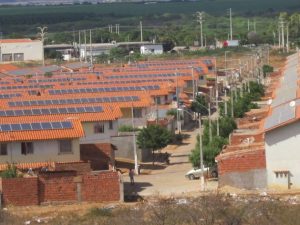
A total of 9,144 solar panels were installed on the rooftops in this complex for a thousand poor families, on the outskirts of Juazeiro in the Northeast Brazilian state of Bahia. The system had a distributed generation of up to 2.1 MW, leaving a surplus whose profits were used for the community and its members. But it was not used until 2016, three years after it was installed, by decision of the regulatory authority. CREDIT: Mario Osava/IPS

By Mario Osava
RIO DE JANEIRO, Jul 28 2020 (IPS)

Solar energy has continued to expand in Brazil during the COVID-19 pandemic and should contribute to the economic recovery in the wake of the health crisis.

That is the assessment of Bárbara Rubim, vice-president of the Brazilian Association of Photovoltaic Solar Energy (Absolar), in charge of distributed generation.

“The pace of growth has slowed down a bit, but it is still exponential,” she said. “The pandemic has had a smaller effect than was expected and the installed power increased 30 percent in the first half of 2020.”

The total potential was 5,918 MW on Jul. 2, up from 4,533 MW at the end of 2019, according to official data from the National Electrical Energy Agency (Aneel), the energy regulator in this South American country of 211 million people.

This is a small amount in a country with a total capacity to generate 172,709 MW.

In Brazil, 60.4 percent of energy is hydropower, 8.7 percent comes from wind, 8.4 percent from biomass, 8.3 percent from natural gas, 5.1 percent from oil derivatives and 2.0 percent from coal.

But solar energy is the fastest growing source of energy, in line with the global trend.

Brazil was a late bloomer when it came to harnessing the enormous solar potential in its vast territory. The initial push came in 2012, when the country adopted rules that encourage distributed electricity generation, also known as decentralised generation because it is based on many small sources.

This coincided with the sharp drop in the cost of installing solar panels, which played a decisive role in the boom in recent years.

But this South American nation lags far behind the foremost countries in the development of this energy source, led by China, which added 30,000 MW last year to end 2019 with 205,700 MW of solar energy, according to the International Renewable Energy Agency (IRENA).

This intergovernmental institution estimates that each installed MW generates 25 to 30 new jobs.

In Brazil, the expansion led to the creation of 37,000 jobs in the last semester, a period in which unemployment rose across the board due to the arrival of the SARS-CoV-2 coronavirus in late February.

The initial forecast of generating 120,000 jobs this year has become more unlikely but has not been ruled out, according to Absolar.

Solar panels generate electricity to pump water to a tank on a neighbouring hill and to supply water by gravity to 120 families in a neighbourhood in Aparecida, a city in the state of Paraíba, in Brazil's semi-arid Northeast. CREDIT: Mario Osava/IPS

Solar panels generate electricity to pump water to a tank on a neighbouring hill and to supply water by gravity to 120 families in a neighbourhood in Aparecida, a city in the state of Paraíba, in Brazil’s semi-arid Northeast. CREDIT: Mario Osava/IPS

The industry had already proved its counter-cyclical nature by growing during the economic recession that hit Brazil in 2015 and 2016.

“In the crisis, people choose products that allow them to save money,” explained Frank Araújo, a solar energy businessman in Sousa, a city of 70,000 in the Northeast state of Paraíba.

Generating your own electricity is good business: the savings on the electric bill cover the initial investment in just a few years, said the owner of Ative Energy, which installs solar plants in dozens of cities in the Northeast region of Brazil.

His company’s turnover fell by 25 percent after the start of the pandemic, in April and May, but it rallied in June, he said.

“Some companies postponed their investments, out of caution until the economic situation becomes more clear,” he told IPS by phone from Sousa. “That happened mainly in the case of industries, but not in the case of pharmacies and supermarkets, which managed to maintain or expand their sales.”

At a national level, Rubim said the largest expansion of solar energy was in the commercial sector, keen on cutting energy costs, as well as among residential consumers.

Rural residents and businesses also invested heavily in this energy source, increasing their generating capacity by 120 percent in the first half of 2020, compared to the same period in 2019, said Rubim, who is also director of Bright Strategies, a renewable energy consulting firm.

This is because rural energy has become more expensive due to the gradual reduction of a discount they enjoyed on the electricity tariff. In addition, rural producers tend to seek “synergies” to make more efficient use of the land, Rubim said in a telephone interview from São Paulo.

According to her analysis, the pandemic will favour renewable sources, especially solar, by reducing costs, including maintenance, and because it will drive up the price of electricity supplied by the distribution companies.

Consumers will have to pay at least part of the so-called “COVID bill” – a bank loan arranged by the government to help the power industry overcome the losses suffered in the face of falling energy demand due to the pandemic.

The loan aims to spread over five years the increase in energy tariffs that would otherwise affect consumers in one fell swoop. However, it will cause an additional cost that will make solar energy more attractive, Rubim hopes.

Solar panels were installed on the roof of the building of the Catholic Archdiocese in the city of Sousa, which houses administrative offices, an auditorium and a sports field. The electricity generated allows the

Solar panels were installed on the roof of the building of the Catholic Archdiocese in the city of Sousa, which houses administrative offices, an auditorium and a sports field. The electricity generated allows the “solar archdiocese” – as it has been dubbed – to save almost all energy costs and thus expand its social work in the municipality of 70,000 inhabitants in Brazil’s Northeast region. CREDIT: Mario Osava/IPS

In addition, interest rates have fallen during the crisis, making it cheaper to provide the necessary credit for investments in solar plants, which are also favoured by greater sensitivity to environmental and climate problems.

Distributed generation, installed by its own consumers, has grown the most in Brazil in recent years. At the end of June, output reached 2,987 MW, three times higher than the previous year, and exceeded by 0.02 percent the output of large commercial plants.

In 2017 distributed generation was equivalent to just 17 percent of centralised generation. But the expansion of decentralised generation has been very uneven across the country.

The state of Minas Gerais, in the southeast of the country, is the leader, with 594 MW of installed power, 19.9 percent of the national total.

The state’s leading position highlights the importance of public policy, Rubim said. In 2013 Minas Gerais adopted the tax incentives, two years ahead of the other 26 Brazilian states.

It also pioneered the authorisation of units of up to five MW for multi-consumer shared generation, a formula allowed by Aneel since 2015.

Solar panels are also disseminated throughout the country for social and environmental reasons.

Sonnenhauss, a company located in João Pessoa, capital of the state of Paraíba, offers training and consultancy, in addition to installing solar energy systems and promoting projects.

Currently, it is installing 13 units in the interior of the state to serve rural communities. The idea is to pump water, in one case to supply 200 families and in others to implement irrigation systems for agricultural production and to promote a fruit pulp factory.

“In addition to the installation, we offer training to local personnel for the maintenance of the equipment and support at all levels,” Manoel Alves, one of the company’s electrical engineers and a professor at the Federal Institute of Paraíba, told IPS from that city.

In the same state, based in Sousa, the Semi-Arid Renewable Energy Committee (Cersa), a group of activists, has already promoted the installation of solar systems in several Catholic dioceses, schools and rural communities.

The “More Light for the Amazon” programme, created by the Brazilian government in February, aims to bring clean, renewable energy to some 300,000 people living in isolated communities that still lack electricity.

“The source will basically be solar, because of the ease of implementation, the low cost and the feasible maintenance, including by trained local residents themselves,” said Joilson Costa, coordinator of the Front for a New Energy Policy for Brazil, which brings together 31 social, environmental and academic organisations.

In the southern state of Paraná, the regional government decided to adopt solar energy in the 5,500 municipal schools in the state, beginning this year with 224 schools in seven municipalities.

The post Solar Energy Expands in Brazil Despite the Pandemic appeared first on Inter Press Service.

Source : African Media Agency (AMA)

Share This Article
LinkedIn Email Copy Link Print
Previous Article Neglected, Sacrificed: Older Persons During the COVID19 Pandemic
Next Article Ride-Hailing App Delivers Contraceptives to Users’ Doorsteps
Leave a Comment

Leave a Reply Cancel reply

Your email address will not be published. Required fields are marked *

Your Trusted Source for Accurate and Timely Updates!

Our commitment to accuracy, impartiality, and delivering breaking news as it happens has earned us the trust of a vast audience. Stay ahead with real-time updates on the latest events, trends.
FacebookLike
XFollow
InstagramFollow
LinkedInFollow
Diestmann

You Might Also Like

Banque africaine de développement : le président Adesina dans le viseur

By
Pan African Visions

Coronavirus – Somalia: Testing for COVID-19 will be done at the Ministry of Health – Somalia National Public Health Research Laboratory (NPHRL)

By
Pan African Visions

New life for South Sudan refugees in Nyumanzi, Uganda

By
Pan African Visions

South Africa: Syndicate of Arsonists Behind Torching, Vandalising of 22 Gauteng Schools

By
Pan African Visions
PAN AFRICAN VISIONS
Facebook Twitter Youtube Rss Medium

About US


Pan African Visions: Your instant connection to breaking stories and live updates. Stay informed with our real-time coverage across politics, tech, entertainment, and more. Your reliable source for 24/7 news.

  • 7614 Green Willow Court, Hyattsville, MD 20785 , USA
  • +1 24 0429 2177
  • pav@panafricanvisions.com
Top Categories
  • Politics
  • Business in Africa
  • Blog
  • Health
  • Sports
  • Entertainment
  • Multimedia
  • Contact
Usefull Links
  • PAV – Home
  • Contact Us
  • About Us
  • Complaint
  • Advertise With Us

© 2026 Pan African Visions. 
All Rights Reserved.